A web tool that forecasts what your AI agent will cost before you build it, and tells you the things to change before you ship to optimize costs further.
A walkthrough of what a user sees upon first entering PitCrew.
TL;DR — A SCREENER CAN STOP HERE
PitCrew is a web tool that forecasts what your AI agent will cost before you build it — and tells you what to change before you ship. I designed and shipped it end to end: solo, 30 days, 217 commits, with AI at the input and output layers only — every number in between is deterministic and traceable. Live at usepitcrew.com, with a real live-mode Stripe purchase validating the Pro tier.
30DAYS — SPEC TO LIVE
217COMMITS — SOLO + AI PAIR
565TESTS PASSING · CI ACCURACY GATE
ROLESolo — design + build
TIMELINEApr–May 2026 · 30 days
TEAMSolo + AI pair (Claude Code + Claude Design)
TOOLSNext.js · Supabase · Vercel · Claude Sonnet · Stripe
01 — CONTEXT
The $400/month agent that should cost five dollars
A friend was paying $400/month for an agent doing work that should cost five dollars — the difference was architecture decisions made in the first hour, never revisited. Most builders hit the same gap: pricing pages show per-token rates that don't translate to a monthly bill, and by the time real usage tells the truth, the agent is already deployed. PitCrew lives in the window before that — pre-deploy, when changing the architecture is still cheap.
✦ NORTH STAR
“Where does $347 come from?” — every decision answers to auditability.
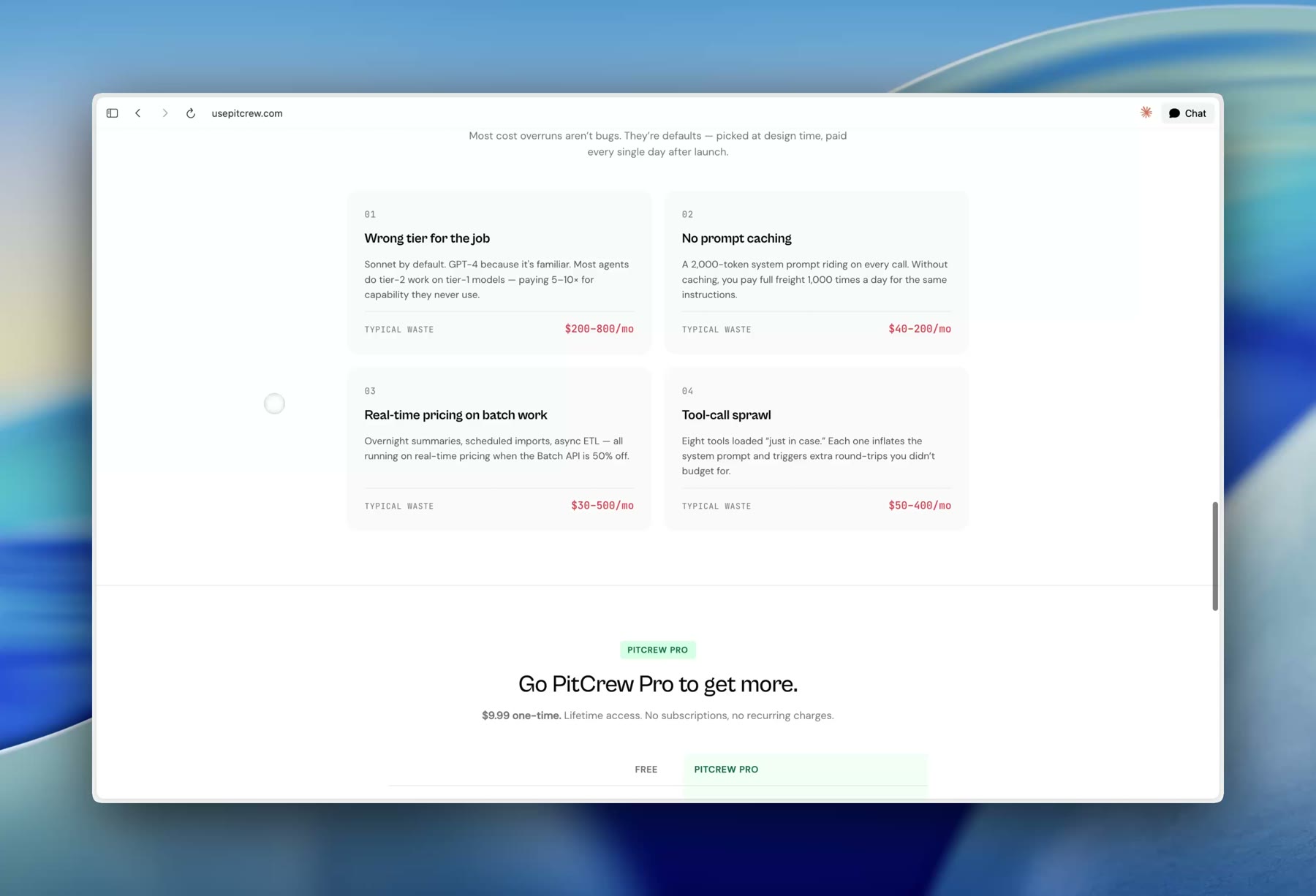
Most cost overruns aren't bugs — they're defaults, picked at design time and paid every day after launch.
02 — SOLUTION
Pre-deploy forecast, not post-deploy regret
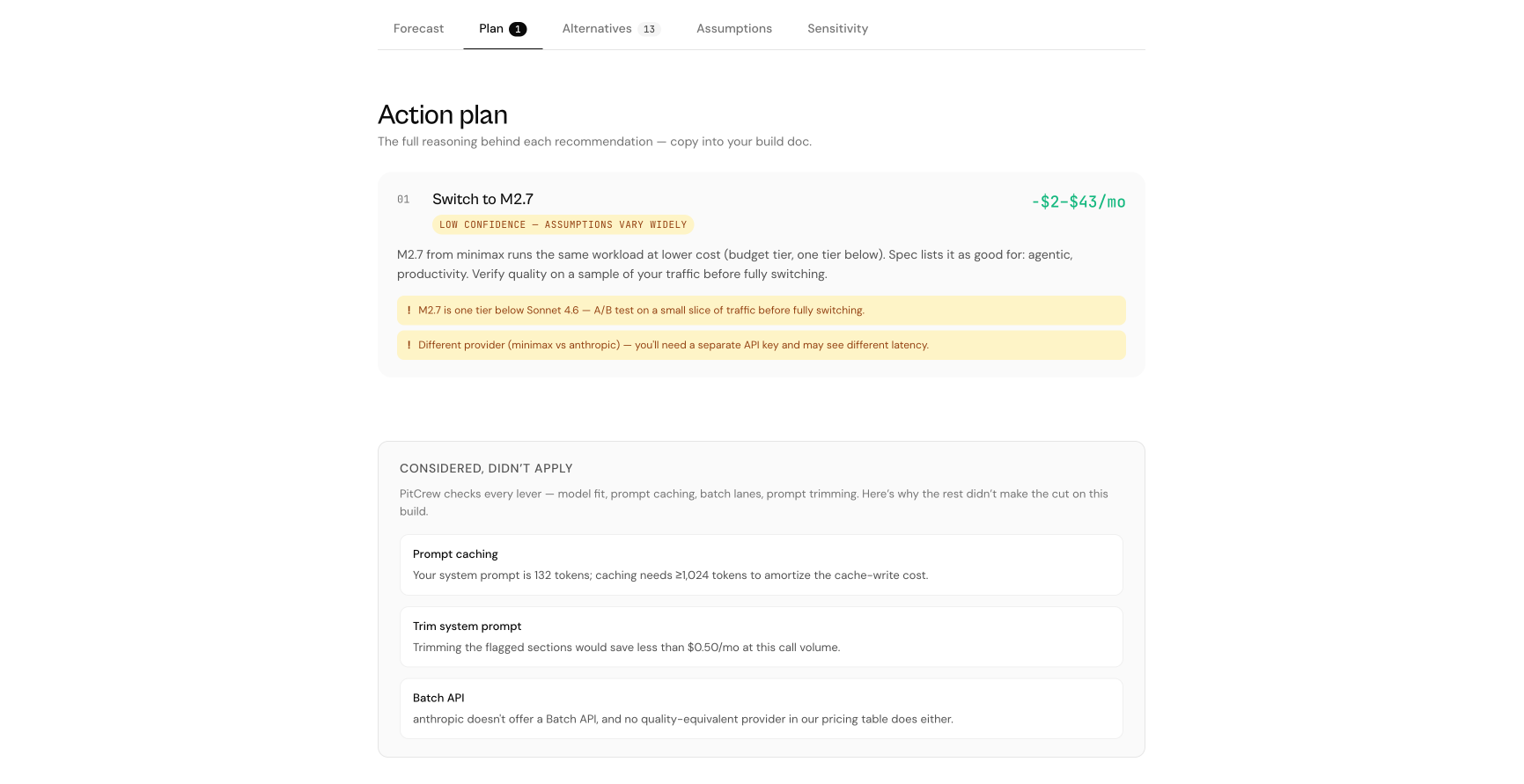
Pre-deploy forecast, not post-deploy ingestion: a developer who reads “you'll spend $400/mo” before writing code can change the architecture — one who reads it after mostly produces regret. PitCrew runs an ensemble of cost-optimization analyzers in parallel and composes them into a cascade, each step's contribution shown atop the running total. The output: a forecasted monthly bill, a ranked action plan, and confidence bands on every figure.
A focused look at the "I don't know" toggle producing a useful forecast despite missing inputs.
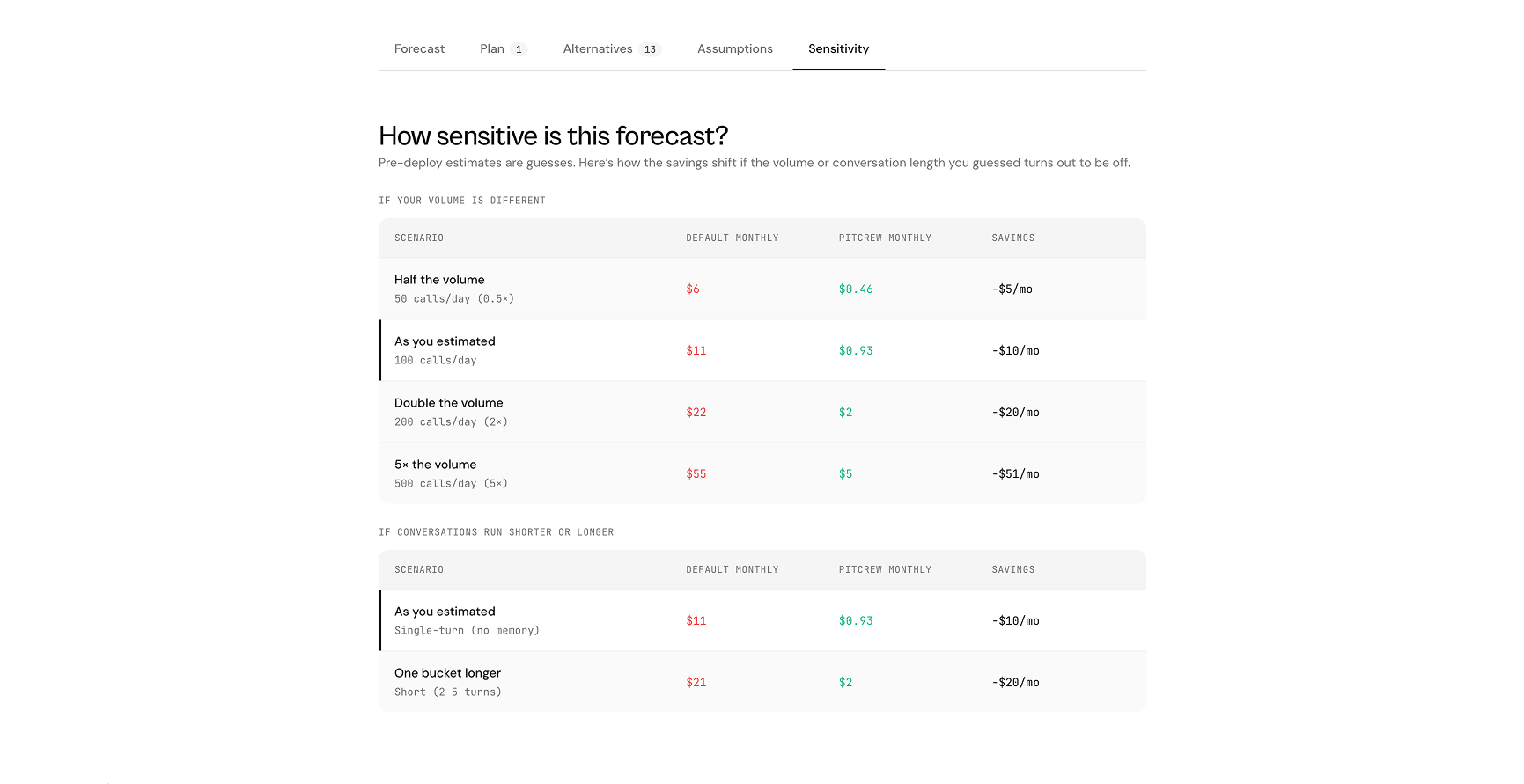
Every input is flagged inferred / typed / unknown — the sensitivity grid shows how the forecast moves if your guesses are off.
03 — UNDER THE HOOD
The same screens, flipped over
AI touches exactly two surfaces — a parser on the way in, a Setup Guide generator on the way out. The LLM never multiplies, prices, or approves a recommendation. Toggle any screen below to see the code behind it.
FRONTENDNext.js 14 · TypeScript strict · Tailwind
BACKENDSupabase (Postgres · Auth · RLS) · Vercel
AIClaude Sonnet 4.5 — parse in, guide out
PAYMENTSStripe — one-time Pro tier
KEY SCREEN A · THE PRO GATE
UNDER THE HOOD · THIS EXACT SCREEN
const isPro = await isUserPro(user.id);
if (!isPro) {
const quota = await getQuotaState(user.id);
if (quota && !quota.allowed) redirect(`/pitcrewpro?reason=quota&resets=${resets}`);
}
const pending = await claimPendingAudit(admin, { id: pendingId, sessionToken, userId: user.id });
if (!pending) redirect("/audit?err=pending_unclaimable");
if (!isPro) await incrementAuditCount(user.id);
Gate → claim → increment, in that order — a failed claim never burns a user's quota.
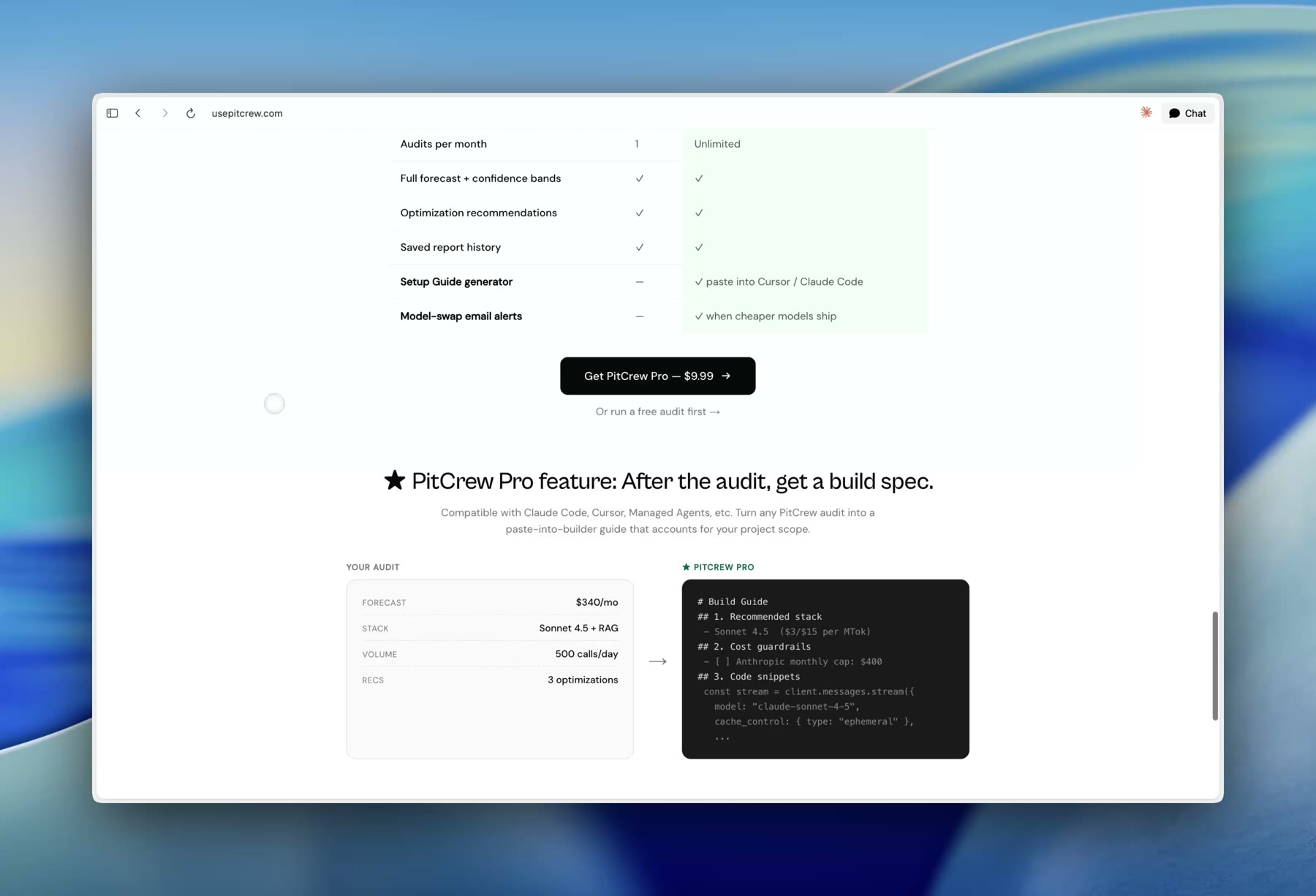
Same screen, both faces — the free tier's edge, enforced server-side. $9.99 once, lifetime.
KEY SCREEN B · THE SHARED REPORT
UNDER THE HOOD · THIS EXACT SCREEN
export function signShareToken(reportId: string): string {
if (!reportId) throw new Error("signShareToken: reportId required.");
const key = loadEncryptionKey();
const mac = createHmac("sha256", key).update(reportId, "utf8").digest();
return b64url(mac).slice(0, TOKEN_LENGTH); // 32 chars ≈ 192 bits entropy
}
32 characters ≈ 192 bits of entropy — and the recipient view strips the agent description and Setup Guide.
Same screen, both faces — shareable proof without giving away the idea behind it.
04 — DECISIONS
What I said no to
✕ REJECTEDPost-deploy auditThe original spec — an ingestion surface was built, then killed five days in. Pre-deploy won: regret vs. leverage.
✕ REJECTEDEnd-to-end LLM pricingPaste a description, model imagines a price — seductive, unauditable. Trust requires deterministic math.
✕ REJECTEDSubscription pricing$9.99 one-time, lifetime — no upgrade-or-lose-it pressure.
✕ REJECTEDSign-in gate at wizard entryThe auth wall moved to the final click to increase conversion; the form survives sign-in via a pending-audit row.
A NOTE ON HONESTY
“The auth wall stayed OFF in production for 16 days — turning it on unmasked three latent bugs in a week. And the engine warns when a configuration falls outside what's been validated: the product admits its own uncertainty.”
05 — REFLECTION
A few things I don't think I could have learned from theory
The real product-design question is “what should be a model and what should be code?” — theory glosses it because the easy answer is “use AI for everything.” Trust collapses the moment a user can't audit where a number came from: a worked example traceable to public rate cards is an answer, “the model said so” isn't. And calibration is the difference between an AI feature you can ship and one you can defend.
 Caleb Kim